The RESkill4NetZero session at EUSEW 2026 moved from skills policy to workforce delivery: exploring career attraction, AI readiness, local coordination and inclusion.
Europe’s renewable energy transition will not be delivered by technology and investment alone. It also depends on whether enough people have the skills to build, install, and operate the systems behind it. Today, that workforce gap is becoming harder to ignore.
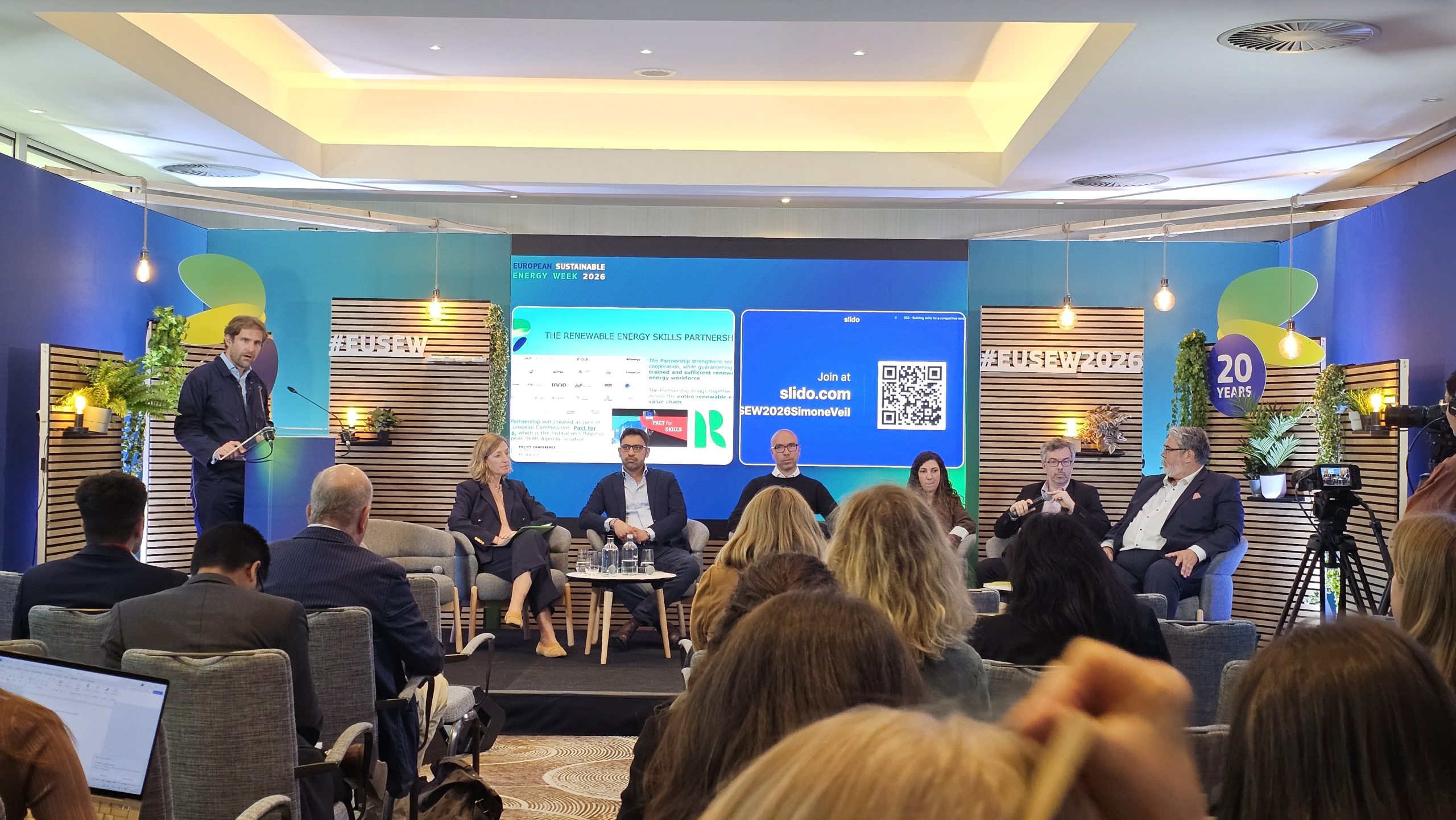
At the European Sustainable Energy Week 2026, the policy session “Building skills for a competitive renewable energy future” brought that challenge into sharp focus. Co-hosted by RESkill4NetZero, represented by InnoEnergy Skills Institute, and the Renewable Energy Skills Partnership, represented by GCP Europe, the session on 11 June was designed not as a panel but as a practical problem-solving exercise. Moderated by Oliver Jung, Secretary-General of GCP Europe and co-coordinator of the Renewable Energy Skills Partnership, the session had participants submit real workforce challenges; panellists and the audience worked through solutions together.
From skills policy to workforce delivery
Eva Schultz, Member of the Cabinet of the European Commission Executive Vice-President Roxana Mînzatu (People, Skills and Preparedness), opened by positioning energy and skills as two of the most important issues for European industry. “There is no competitiveness without a competitive skills base,” she said, framing Europe’s industrial strength as resting on the expertise and capacity of its people.
She stressed that the human dimension must be central and pointed to initiatives such as the Union of Skills, launched last year, as part of the European Commission’s response. The initiative reflects a shift away from treating skills policy in isolation, bringing it closer to economic, industrial and energy policy rather than leaving it solely within education debates. Within the net-zero economy, the Net-Zero Industry Academies are European Commission-backed skills platforms created to close the workforce gap in the clean energy transition. The European Solar Academy, developed with industry to close the skills gap in solar PV, is one concrete example. Another flagship project is RESkill4NetZero, explicitly designed to support the Renewable Energy Skills Partnership and to address the shortage of skilled workers in the renewable energy sector.
The workforce gap it is responding to is documented and immediate. Half of energy organisations report critical hiring bottlenecks (IEA, 2025), with structural shortages concentrated in technicians and specialised engineers, a current problem, not a future risk. Demand for workers across the battery, solar, wind, hydrogen, and heat pump value chains is roughly twice the available supply. As Elias Paul, Head of Operations at InnoEnergy Skills Institute, put it: “Today we don’t have a technology problem. What we have is a scaling problem.”
The labour market picture from LinkedIn adds a further dimension. Mirek Pospíšil, Public Policy & Economic Graph Lead at LinkedIn, presented data from the Economic Graph. His core message: green skills are now diffusing across the entire workforce. With year-on-year growth of 8.0%, the share of job postings requiring green skills is growing twice as fast as the share of workers who have them (4.3%). For the first time, professionals with green skills in non-green job titles make up 53% of all green hires. Energy management is the world’s fastest-growing green skill category; sustainability education, waste prevention and sustainable procurement follow.
Making renewable energy careers visible earlier
One of the session’s strongest themes emerged from the audience: how do you attract students to renewable energy careers before they reach formal training? Across all panellists, the answer pointed to earlier, more direct and more personal engagement.
Olivier Bardou, Director of Corporate Services at Energy Formation, affiliated with GRDF, argued that the first step is often overlooked: “The first path to attracting students is also attracting professors and teachers to this sector.” If teachers have not seen the sector themselves, they cannot credibly guide students towards it. Energy Formation’s response to this is its learning-by-doing model — training around 12,000 people each year using real-life infrastructure and real networks, reinforcing what the sector actually looks like in practice.
Marina Casanova, co-founder of Women+ in Concentrated Solar, described researchers going directly into schools — sometimes from age 10 or 11 — and running small experiments to make technical concepts concrete. The effect extends beyond the information conveyed. “If other female colleagues or I go, the young women in high school will see that there is a model,” she said. “They will not think this is a career path for men.” The visibility of women in technical roles changes what young women consider possible for themselves.
Mirek Pospíšil added the image problem: many people hold outdated ideas about what industrial and technical roles look like today. To help close that gap, LinkedIn has been piloting short videos from young creators already working in green roles, making careers feel recognisable rather than remote.
Skills for the AI era: physical, digital and human
An audience question asked which skills will remain most resilient as AI reshapes the sector. The discussion that followed was not primarily about digital tools.
Olivier Bardou was direct: “The renewable sector will always be something very physical.” Understanding energy systems, infrastructure, and how components fit together remains foundational, regardless of what AI sits on top of them. Pedro Dias, Deputy Managing Director at Solar Heat Europe, also framed AI as a complement rather than a replacement. In installation, for example, AI can help make work easier for installers by reducing complexity, lowering the risk of installation errors, and enabling remote monitoring of systems. In that sense, “it can make these jobs more appealing while keeping the installer’s role central”, he affirmed.
The discussion on resilience pointed in the same direction. Mirek Pospíšil warned against searching for a single guaranteed skill: “It’s not like there is one skill that will make sure that you are employable all the time.” The more durable foundation is a combination: growing digital fluency alongside communication, teamwork and stress management, which Casanova noted can all be developed through training. Elias Paul also emphasised adaptability and agility in a constantly changing market.
Local ecosystems and the coordination gap
A recurring concern from the audience was fragmented delivery. The clean energy skills agenda can look coherent at the EU or national level and fall apart in practice, because renewable potential, local employers, training infrastructure and labour markets differ sharply by region.
Marina Casanova called for better links between policymakers and practitioners: “We need more connection between policy and the people who are really working on it.” She pointed to the European Energy Research Alliance as one structure that does this effectively, acting as a genuine bridge between researchers and the Commission.
Mirke Pospíšil drew on France’s efforts to rebuild talent pipelines for nuclear energy: working with the national employment office at the regional level to source candidates and identify needed skills. Localised, he argued, is what works. Olivier Bardou reinforced this from GRDF’s experience in western France: a federation of industry, training and local policy actors working together creates a circular dynamic that national frameworks alone cannot replicate.
Pedro Dias challenged municipalities directly: “How much energy are they importing into their municipality, into their region, and how much does it cost?” Local authorities that understand how much energy they import and the cost of that dependency have a clear economic reason to invest in local renewable production. That production creates local jobs; local jobs require local training; local training requires schools, employers, and policy actors to work together.
Inclusion as a workforce strategy
Women hold around 43% of jobs across the economy, but only around 30% in renewable energy. That gap is not a separate equity issue; it is a direct constraint on the sector’s capacity to expand.
Marina Casanova identified the barriers as cultural, organisational and structural. Her proposed responses are practical: mentorship, gender-sensitive training, visible role models and workplace cultures that retain female talent. “Leadership roles need to take some responsibility,” she said.
Inclusion is placed within the broader workforce challenge: Europe needs the full potential of its population — across age, gender and geography. That means young people entering for the first time, mid-career workers reskilling, women moving into technical roles and workers crossing sectors and regions. Skills portability and labour mobility are part of the Commission’s efforts to make that possible. Elias Paul noted that training should be built from job profiles and required skills, not from existing course structures. This also helps candidate countries and regions outside the EU benefit from standardised training materials. “Industry, policy and training need to align and become the force multiplier,” he added.
The skills gap is also a confidence and visibility gap. Opportunities exist but are not always visible, attractive, or trusted. Young people, workers, and companies need confidence that careers in renewable energy have a future. SMEs, local employers, and municipalities need support to make opportunities visible.
From discussion to continued collaboration
The session did not resolve Europe’s renewable energy skills shortage. It was not designed to. What it produced was a structured set of practitioner-level challenges and a set of concrete responses that can feed directly into ongoing work through projects such as RESkill4NetZero.
The message that ran through the entire discussion was consistent. The barrier to Europe’s renewable energy future is not technology. It is the people pipeline, and building that pipeline requires visible career pathways, training tied to real jobs, coordinated ecosystems at the right local level, and a workforce development approach that draws on all available talent.
Watch the full recording of the session below to explore the discussions, insights, and perspectives shared by our speakers.